Why is praying hard?
This short article is on point. Burk Parsons knows a thing or two and shares effectively. “If I thought for a second that my feeble prayers changed God’s mind and His perfect will, I would stop praying altogether. I’m sinful. I don’t know everything, and I can’t control everything. Yet because God is omniscient and omnipotent, and because He has our ultimate good and His glory in mind, we can trust Him.” The rest is here.
https://tabletalkmagazine.com/article/2019/03/why-is-it-so-hard-to-pray/
TLI Journal of Global Christianity
https://trainingleadersinternational.org/resources/jgch

Training Leaders International just released the newest edition of the Journal of Global Christianity. The journal is available in five languages: English, French, Spanish, Chinese, and Farsi. You can download the PDF in
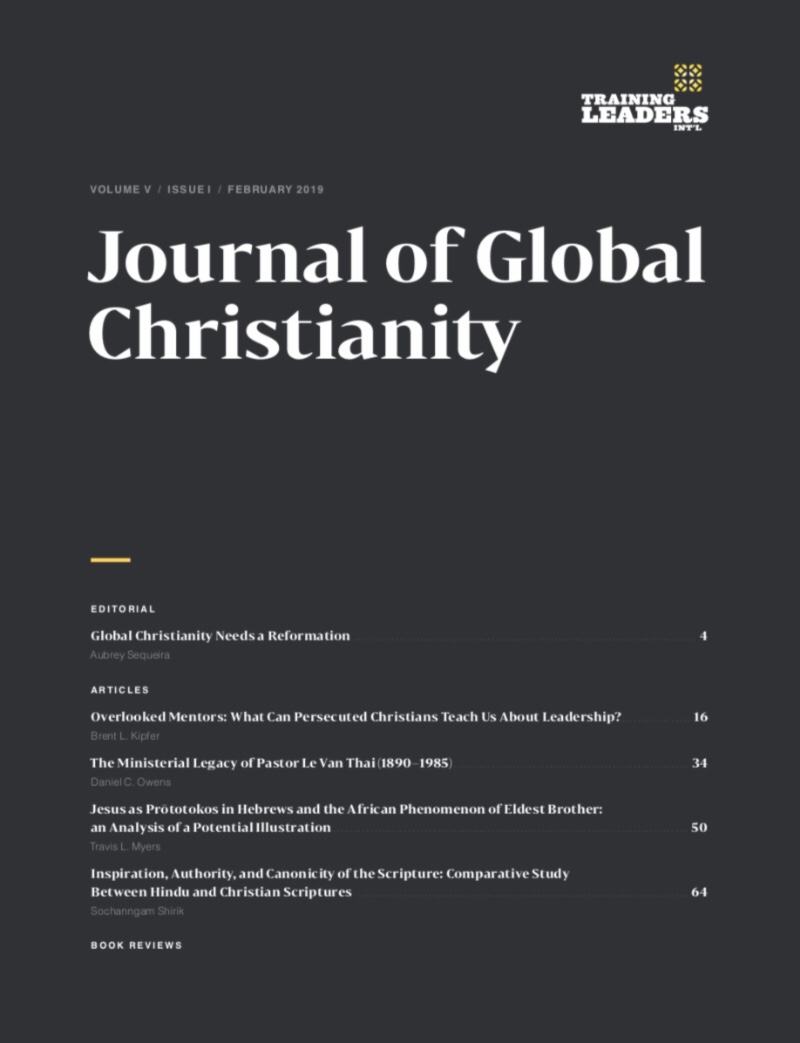
various languages or read it on our website in English.
The Journal of Global Christianity seeks to promote international scholarship and discussion on topics related to global Christianity. The journal addresses key issues related to the mission of the Church, in hopes of helping those who labor for the gospel wrestle with and apply biblical teachings on various challenging mission topics. The journal targets an audience of pastors, missionaries, and Christian workers around the world.
This volume has the following contributions:
1 Aubrey Sequeira l Global Christianity Needs a Reformation
2 Brent L. Kipfer I Overlooked Mentors: What Can Persecuted Christians Teach Us About Leadership
3 Daniel Owens l The Ministerial Legacy of Pastor Le Van Thai (1890-1985)
4 Travis L. Myers l Jesus as Prototokos in Hebrews and the African Phenomenon of Eldest Brother: an Analysis of a Potential Illustration
5 Sochannagam Shirik l Inspiration, Authority, and Canonicity of the Scripture: Comparative Study Between Hindu and Christian Scriptures
6 Book Reviews
Join me in praising God for all those who made this journal possible. May the Journal also be an encouragement to our brothers and sisters around the world. Please share it with workers around the world, particularly those for whose language we translated the material.
Training Leaders International
121 South Eighth Street
Suite 940
Minneapolis MN 55402
51 Reasons to read the Bible
This list is not exhaustive. But it is enough. We live by the Word, because Jesus is given to us by the Holy Spirit through the Word. Five minutes every days isn’t enough. Ten is not enough. God is speaking. To me. Supernaturally.

- Jesus said that if you abide in his words, you are truly his disciples, John 8:31.
- Christ’s words will set you free from your slavery to sin, John 8:32-34.
- The Bible is truly true and can never be wrong, John 10:35.
- Reading and obeying the Bible will give you the joy that God has, John 15:11.
- Living, abiding in, and loving the Bible means living, abiding in, and loving Christ, John 15:4-5.
- Abiding in, living in the Bible means bearing spiritual fruit, John 15:5.
- Without the Word you will pray wrongly and you will not be able to accomplish anything, John 15:5.
- With the Bible as your guide, your prayer requests are always answered, John 15:7.
- The Bible is the primary means by which you become more like Christ, John 17:17.
- God appears to you by his Word, 1 Samuel 3:21.
- God watches over his Word to perform it; therefore, you can read the Bible to see what God has done, is doing, and is going to do, Ezekiel 36:36; Jeremiah 1:12.
- God blesses you when you delight in his Word, Psalm 1.
- God’s Word will enable you to do God’s will, Joshua 1:8.
- Listening to the Scriptures will astonish you, Mark 11:18.
- Read the Bible carefully and meditatively so that it becomes the joy and delight of your heart, Jeremiah 15:16.
- The message of the Bible will cause you to ask for God’s mercy, Daniel 2:18.
- The Scripture are pure words, refined words. They are the best words, Psalm 12:6.
- The Bible is about Christ, our highest treasure, John 5:39; Matthew 13:44.
- When you find Christ in the Scriptures, it gives you joy, Matthew 13:44
- When you find Christ in the Bible, it will cause you to evaluate what you value, Matthew 13:44
- The Scriptures show you Christ, who can truly revive your soul, Psalm 19:7
- The Bible opens your eyes to see truth, Psalm 19:7.
- When you obey/keep the Scriptures, there is great reward, Psalm 19:11.
- The Bible is used by God to warn and keep you from evil, Psalm 19:11.
- When you listen to God in the Bile, you have chosen the best part, Luke 10:39.
- Reading the Bible is an act of obedience to God, Luke 9:35.
- When you read the Bible you will not be put to shame, Psalm 119:6.
- Reading the Bible will cause you to praise God, Psalm 119:7.
- The Scriptures show the wondrous work of God, Psalm 119:27; Psalm 78:1-8.
- Reading the Bible helps turn you away from an inordinate commitment to worthless digital devices and gives you life, Psalm 119:37; Jeremiah 6:19.
- The Bible helps you understand affliction, Psalm 119:75.
- A commitment to the Scriptures gives other Christians great joy, 2 John 4; 3 John 4.
- The Bible trains you to live righteously, 2 Timothy 3:16.
- The Bible equips you for good works, 2 Timothy 3:17.
- God’s Word enables you to withstand temptation and keeps you from sinning, Matthew 4:1-11; Psalm 78:7-8.
- The Bible enables you to know the mind of God, 1 Corinthians 2:9-16
- Abiding in God’s Word enables you to walk in the Spirit, Romans 8:5-6; 1 Corinthians 2:9-16.
- Abiding in God’s Word gives life and peace, Romans 8:5-6; 1 Corinthians 2:9-16.
- Commitment to the Scriptures is required to be filled with the Spirit, Ephesians 5:18-21; Colossians 3:16-17.
- Those outside the faith do not have this privilege of reading the Bible with understanding, Deuteronomy 4:8.
- The Lord gives understanding when reading the Bible, 2 Timothy 2:7.
- The Scripture gives insight into the mystery of Christ, Ephesians 3:4.
- The Bible isn’t that hard to understand, Deuteronomy 30:11.
- The Bible enables you to walk in the Spirit, Romans 8:5-6; 1 Corinthians 2:9-16.
- The Scripture gives life and peace, Romans 8:5-6; 1 Corinthians 2:9-16.
- Reading and understanding the Bible is required to be filled with the Spirit, Ephesians 5:18-21; Colossians 3:16-17.
- The Lord gives understanding when you read the Bible, 2 Timothy 2:7.
- The Scripture gives insight into the mystery of Christ, Ephesians 3:4.
- The God of peace promises his presence when we live like the Apostle Paul, who read the Bible all the time, Phil 4:8-9.
- When you read the Bible and remember it, it keeps you from sinning, Psalm 119:11.
- The truth about Jesus’ work on the cross and the necessity of belief and repentance is found in the Bible only, Romans 10:17.
Elisabeth Elliot
If Elisabeth Elliot writes it, we should read it. She is a model of clarity, biblical grounding, compassionate truthfulness and consistency. And she street-wise experience to call us to listen.

